Backend and workflow engineering in Go, Python and Temporal

BuildKodiq builds the backend parts that can't drop a job: APIs and microservices in Go and Python (FastAPI), long-running workflows on Temporal that retry and resume after crashes, event-driven systems over RabbitMQ and WebSockets, and the Kubernetes and CI/CD setup underneath. Our largest example is SpotBeam, which automates TV and radio ad delivery to stations for a US broadcast ad-distribution company.

New joborder, file, eventWorkflow modelsteps, retriesTemporalsaved every stepWorker queuesscale separatelyYour systemsAPIs, RabbitMQStatus, alertsevery jobNew joborder, file, eventWorkflow modelsteps, retriesTemporalsaved every stepWorker queuesscale separatelyYour systemsAPIs, RabbitMQStatus, alertsevery job
How we would build it. Scroll to see each step.

Problems this solves

  • Multi-step jobs fail halfway and someone restarts them by hand.

    Solved by: Temporalsaved every step

  • One slow step (a transcode, an AI call, a sync) holds everything else up.

    Solved by: Worker queuesscale separately

  • Nobody can tell where a job is, or why it failed.

    Solved by: Status, alertsevery job

Use cases

  • Order, document and media pipelines with many steps and external systems.
  • Long-running AI agent jobs that run for minutes or hours.
  • APIs and microservices for SaaS products and mobile apps.
  • Adding automation around an existing system (C#, Java, PHP) without a rewrite.

How we build it

New joborder, file, eventWorkflow modelsteps, retriesTemporalsaved every stepWorker queuesscale separatelyYour systemsAPIs, RabbitMQStatus, alertsevery jobNew joborder, file, eventWorkflow modelsteps, retriesTemporalsaved every stepWorker queuesscale separatelyYour systemsAPIs, RabbitMQStatus, alertsevery job
  1. Step 1: Model the workflow

    Every step, retry rule, timeout and human approval written down, so failure handling is designed rather than patched.

  2. Step 2: Durable execution

    Temporal (or Inngest / DBOS for smaller jobs) so each step is saved and resumes after crashes or deploys.

  3. Step 3: Scale the slow parts

    Separate worker queues per kind of work, scaled on their own on Kubernetes.

  4. Step 4: See everything

    Status, history and alerts for every job, with logs and tracing in production.

What you get

  • Go or Python services and APIs
  • Temporal workflows and workers
  • Queues and event handling (RabbitMQ, WebSockets)
  • Docker, Kubernetes and CI/CD
  • Monitoring and runbooks

Handed to your team

Why BuildKodiq

  • Production Temporal experience, not just tutorials: SpotBeam runs parallel per-station child workflows with human-in-the-loop pauses.
  • The same two engineers own the code, the deploys and the monitoring.
LeadReviewerPreviewPRapproved
Every project has a lead engineer, and a second engineer reviews every pull request. We work US Eastern business hours and take projects directly, through Upwork or white-label through agencies.

Related projects

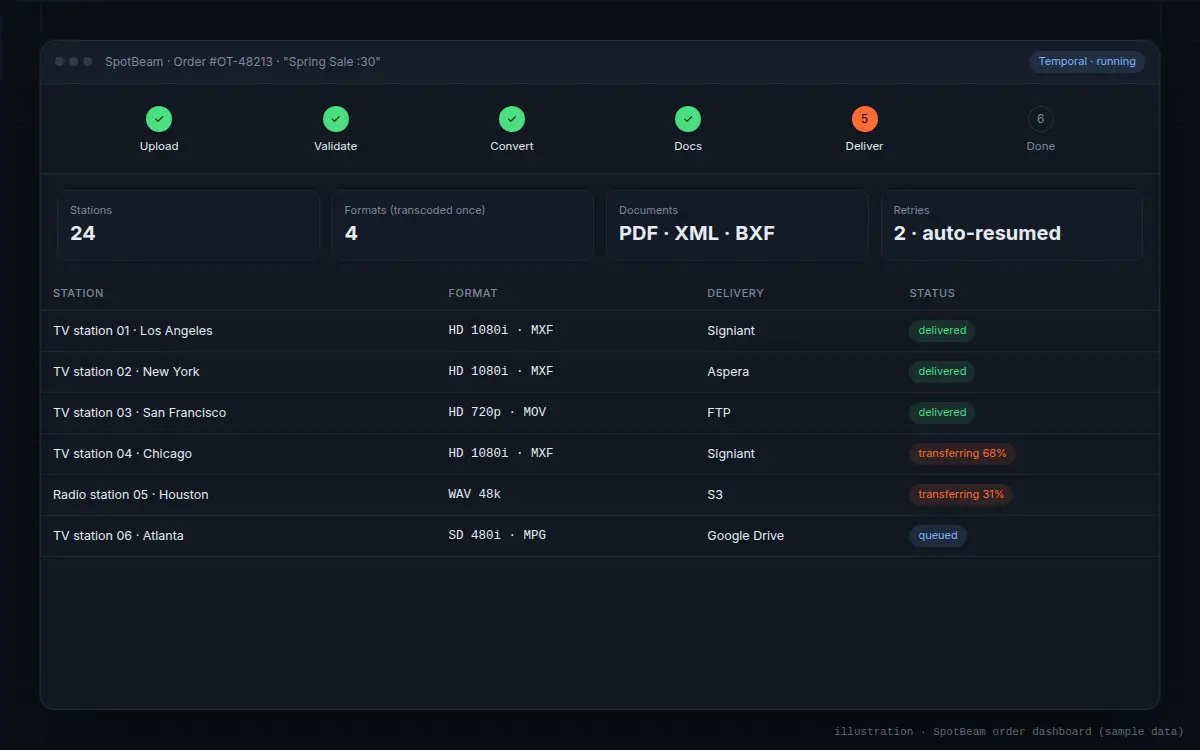
Illustration of the SpotBeam operations dashboard showing an ad order delivering to TV and radio stations in different formats (sample data)

SpotBeam: ad order automation & distribution

Media & broadcasting · New York & Los Angeles

Automating how a US broadcast ad-distribution company checks, converts and delivers TV and radio commercials to stations, from upload to confirmed delivery.

  1. Upload
  2. Validate
  3. Convert
  4. Generate docs
  5. Deliver to stations
  6. Done
End-to-end
automation of a manual ad-order pipeline
Parallel
delivery to many TV and radio stations, each in its own format
Durable
fault-tolerant execution: no order is ever lost
Read the case study

Backend & workflow engineering: common questions

When is Temporal worth it?

When a job has several steps, talks to outside systems, can take minutes or days, or must never run twice or be lost. For short background jobs, a queue or Inngest is simpler.

Go or Python?

Go for high-throughput services and streaming; Python (FastAPI) where AI libraries and data work matter. Many of our systems use both.

Can you work with our existing backend?

Yes. On SpotBeam we integrated with the client's existing C# services over RabbitMQ instead of rewriting them.

Talk to us about Backend & workflow engineering.

A free call with the engineer who would lead your project. You leave with a clear next step, whether or not we work together.

or write to hello@buildkodiq.com