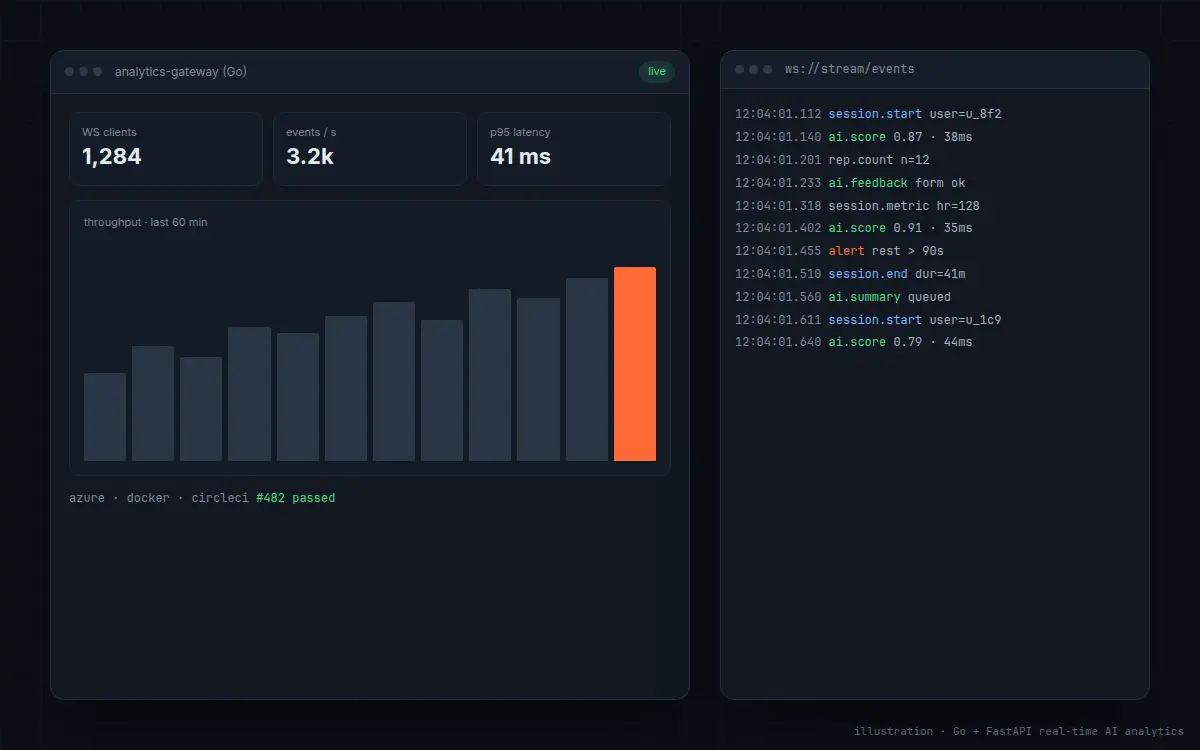
Real-time AI Analytics Microservices
Go and FastAPI services streaming AI analytics to live clients over WebSockets, deployed on Azure.
Read the case studyBuildKodiq builds dashboards and apps where data has to arrive live: analytics screens, operations dashboards and alerting. We use Next.js and React on the front end and Go or FastAPI services streaming over WebSockets behind it. Shipped examples include real-time AI analytics microservices in Go, an internal algorithmic trading build with a Next.js dashboard, Visneo's multi-store operations dashboard, and live classroom streaming for 50+ institutions.
Users refresh the page to see new data, or miss the moment that mattered.
Solved by: Live screenstables, alerts
The dashboard slows down or drops connections as data and users grow.
Solved by: Stream layerreconnect, backoff
Alerts, filters and history live in different tools, so nobody trusts the numbers.
Solved by: One storenever stale
We pin down every event the backend sends (shape, rate, ordering) before building screens, so the UI and API agree from day one.
WebSocket client with reconnect, backoff and resubscribe; state kept in one store so a dropped connection never shows stale data as live.
Virtualised tables and throttled renders so thousands of updates a minute stay smooth, with filters, muting and history over REST.
Sign-in, roles, payments, and an admin view, tested against a staging backend before launch.
Handed to your team
Go and FastAPI services streaming AI analytics to live clients over WebSockets, deployed on Azure.
Read the case studyYes. We work from your API docs or payload samples, build against your staging server, and agree the event contract with your backend team before we build screens.
Next.js when there are public pages too (marketing, stats, SEO); a React single-page app behind sign-in is fine for the app itself. We often do both: Next.js for the site, a React app for the dashboard.
Batch updates per animation frame, virtualise long lists, keep one normalised store, and never re-render the whole page for one row. We test with recorded or simulated feeds at peak rates.
Yes. We've integrated Stripe, Razorpay, PhonePe, Plaid and QuickBooks.
A free call with the engineer who would lead your project. You leave with a clear next step, whether or not we work together.
or write to hello@buildkodiq.com